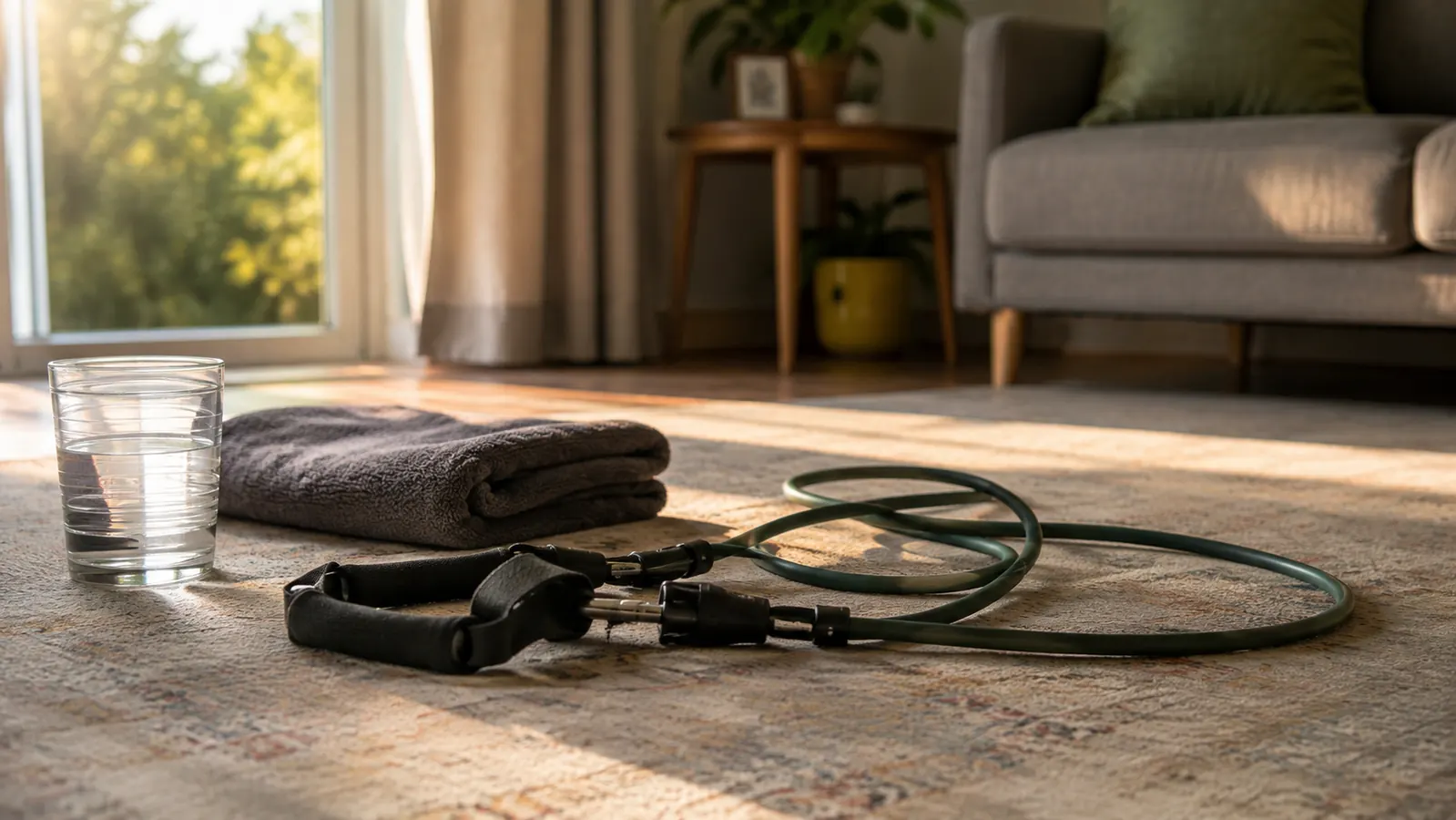
Two winters ago my right knee let me know, in that particular way knees do, that my dumbbell routine was over for a while. Every squat and lunge I'd leaned on for years became a negotiation, and my garage bench started collecting dust the way it had after my back episode. I was sure strength training was done for me, until a physical therapist friend set a WHATAFIT band set on my kitchen table and told me to start boring: seated rows, band presses, no bending under load. Nine months later that set lives in my closet, comes out five mornings a week, and is the reason I train at all.
These are the WHATAFIT resistance bands with handles, a five-level set marketed everywhere as the joint-friendly way back to strength. With over 36,000 reviews on Amazon it is one of the most popular band sets around, which is exactly why I wanted to test it long enough to find the flaws the listing hides. Here is what nine months of regular use actually taught me, including the parts the photos do not show.
The Quick Verdict
For anyone over 50 rebuilding strength around cranky joints, the WHATAFIT five-band set is a genuinely useful, honestly built way in. The door anchor and the thickest band have limits, and the listing does not tell you about them, but the core of the set earns its place every single day.
Amazon Check Today's Price →Start boring. Finish surprised.
The WHATAFIT set covers five levels of resistance in one bag small enough to live in a closet. If a comeback that starts gentle sounds like your situation, check today's price before you talk yourself out of five boring minutes a day.
Amazon Check Today's Price on Amazon →How I've Used It
I train five mornings a week, but that sounds more disciplined than it is. Most days it is fifteen minutes before coffee, a short band circuit at the edge of the living room rug, because nothing about the setup asks me to drive to a gym or clear a bench. Monday is rows and presses, Wednesday is band squats kept shallow and careful, Friday is the same circuit a level or two harder. The other two mornings are core work with the thin bands anchored to the door frame.
My usual circuit is a mix that covers the whole body gently: seated rows, chest presses against the anchor, band pull-aparts, some shoulder work, and shallow goblet-style squats with the loop under my feet. Each exercise is two or three sets of ten to twelve. That is not an ambitious program, and that is the point. At 58, coming off a knee complaint and a back episode before it, my job is consistency, not intensity, and these bands make the consistent version the effortless one.
The progression has been the quiet win. The set ships five bands from thin to thick, and they clip together, so I can add a band rather than jump a whole size. That fine control is what a returning body needs. I can make an exercise a touch harder every couple of weeks without my knee or my back deciding the jump was too much. For anyone rebuilding, that control beats a gym stack of fixed weights every time.
A typical morning stays under twenty minutes from first stretch to last, because nothing about the set fights me. The bands came in a bag that hangs in the closet, and they are out and ready before the coffee finishes dripping. That friction-free start is the real reason this routine stuck when my garage gym did not.
One Sample Morning, Start to Finish
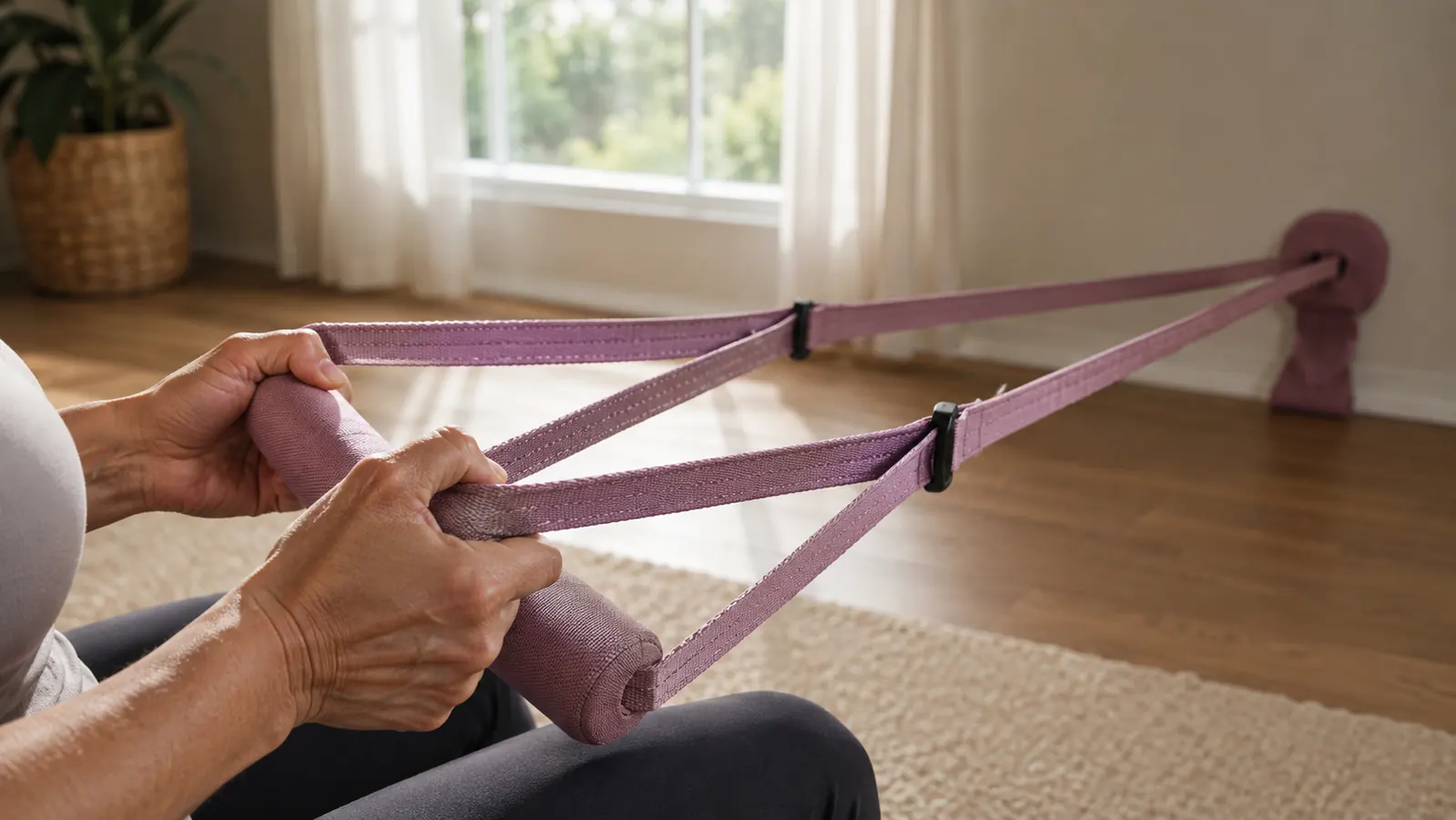
To make this concrete, here is the fifteen minutes from a Tuesday in late spring. I pour the coffee, set it on the counter, and pull the WHATAFIT bag from the closet. Out come the medium band, the padded handles, and the door anchor. I close the wedge in the back bedroom door, high enough that a press starts at mid-chest, and I am ready before the coffeemaker finishes its last gurgle.
First is a set of seated rows against the anchor, thirty seconds of easy pull-aparts to wake the shoulders, because nothing about my body enjoys a cold start. Then rows proper, two sets of twelve with the medium band, and the growing tension means the last three reps are the honest ones. Then band presses against the anchor, two sets of twelve, keeping my shoulder blades down like my physical therapist is watching. I finish with some band pull-aparts, the light band, and a fold of the same medium band for shallow banded squats, no load on the knee, and I hold onto the door frame out of habit.
Fifteen minutes from anchor to bag back in the closet. No mat to roll, nothing to load, nothing to put away. The whole thing fits in the pocket of a morning. That, more than any feature, is why this set carried where a rack of dumbbells could not: there was never a reason not to.
A note on portability, since it has quietly been one of the best things about this set. Last fall a few of us rented a mountain house together, and my whole training came along in the bottom of a weekend bag. No checked case for plates, no hunt for a rental gym. I used the door anchor in the bedroom and had my fifteen minutes on a borrowed floor before anyone else was up. At this age, a routine you can keep when you leave town is a routine that survives.
The Five Levels, and How the Resistance Actually Feels
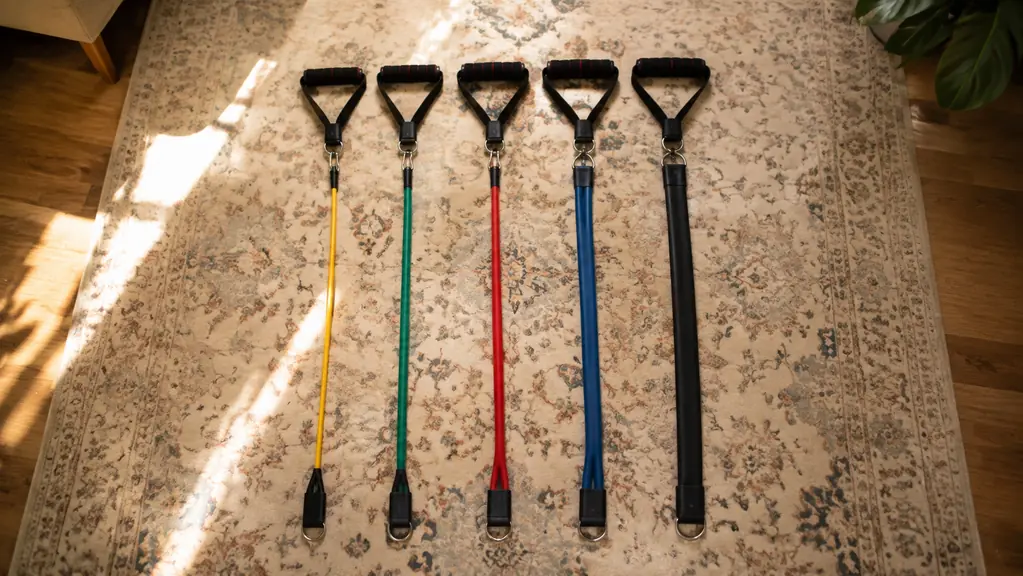
The set's whole promise is the five colored bands, each a step in resistance, all clipping to the same pair of padded handles. Laid out they run from a very light band for shoulder work up to a genuinely heavy one that I use for rows and presses. That range is the reason the set covers a full-body program instead of just one or two exercises.
Let me be honest about how resistance bands feel versus weights, because it matters after 50. A band's load grows as it stretches, so the last few inches of a press are the hardest part. That is different from a dumbbell, where a curl is equally hard throughout. At first it felt backward, but for aging joints it is actually a gift: the move disappears tension when the joint is at its most vulnerable, at the start, and builds it where the muscle is strongest. My knee never once complained about a band squat the way it did about the dumbbell version.
The two lightest bands have become my daily companions for pull-aparts and shoulder work, the kind of maintenance that keeps a 50-something shoulder from getting cranky. The thickest band is where the honest limits live, I will get to those. But for the middle range, which is where nine-tenths of a returning lifter lives, the resistance feels right, smooth, and easy to control.
The Hardware: Handles, Door Anchor, and What Wears
The padded handles are the piece you touch every rep of every day, and they have held up better than I expected for a set at today's price. Nine months of sweaty hands and daily use, and the foam shows no flattening, the stitching is intact, and the clips still click together cleanly. Handles are where a cheap band set cheapens out, and these did not.
The door anchor is the other workhorse, a foam wedge you close in a door with a loop of webbing that holds the bands. I use it for rows and presses daily, and it has never slipped on me. The one honest reach tip: use a door you do not mind putting a foam wedge in, and hang it high enough that your press starts mid-chest. It takes a day or two to find your spot.
The included ankle straps and the small carabiner came along in the bag, and I was honest with myself about them: I mostly do not use them. The ankle straps are fine for leg work, but I train my legs shallow with the loop band instead, because my goal is gentle consistency, not chasing burn. That is a use-case thing, not a quality complaint. The hardware is built fine, I just found my own routine.
Do the Bands Stretch Out Over Time?
This is the question everyone asks about bands, and I wanted to answer it fairly rather than assume. Nine months in, the two lightest bands have relaxed a little, enough that I notice the easiest setting is now a touch easier than it was. That is real, and it is the normal aging of any band you use daily, not a defect in this set.
The good news is that the set gives you a built-in answer. Because the levels overlap and clip together, when a thin band softens you simply add the next one or step the exercise up a level. The progression absorbs the drift. The thickest bands, which are the ones doing the real work for rows and presses, show no meaningful stretch in nine months, and that is what matters most.
A small care habit keeps them honest longer. I hang mine rather than leaving them in a knotted pile, and I keep them out of direct sun, which degrades latex. The WHATAFIT bands are actually a fabric-covered style, which I was relieved to find, because it means they do not snag on sweat or pick up the tacky feel some latex bands get. That fabric outer is a genuine reason to pick this set over a bare-latex one.
The bands did not get me back into strength training. They removed every excuse I had not to, and for a knee that had quit on me, that was the whole battle.
The Honest Limits the Listing Leaves Out
Here is the part the marketing photos and most of those 36,000 reviews do not tell you. First, the thickest single band is an upper-body level, not a leg level. If you want serious lower-body load you will clip several bands together, and even then you are chasing a ceiling that a barbell clears easily. For the arms, shoulders, and back of a returning lifter, the range is plenty. For heavy legs, it is not, and pretending otherwise sets you up to be disappointed.
Second, the door anchor is brilliant for the two directions it is built for and awkward for any press that angles sideways. Diagonal work pulls the wedge toward the gap and it can shift. I can it by picking a high anchor and keeping my presses perpendicular to the door. It is a quirk to learn, not a reason to skip the set.
Third, there is the honesty about progression. Bands are excellent maintenance and a genuine return to training, but they are not a replacement for heavy loaded strength work once you are ready for it. If your eventual goal is serious barbell strength, treat the WHATAFIT set as a bridge back to the gym, not the destination. If your goal is the more realistic one, which is staying strong, mobile, and out of pain at 58, this set is the whole answer.
What I Liked
- Five genuinely distinct levels cover a full upper and core body program
- Fabric-covered bands stay clean and stretch smoothly, no tacky latex feel
- Grows load as it stretches, which is gentle on aging knees and backs
- Small enough to live in a closet and be ready in under a minute
- Padded handles and stitching have survived nine months of daily use
- Fine level control lets a cautious comeback stay cautious
Where It Falls Short
- The heaviest band is an upper-body level, not a leg level
- The two lightest bands have relaxed a little with daily use
- Diagonal work with the door anchor can pull the wedge out of the door
- A bridge back to training, not a replacement for heavy loaded work
Who This Is For
Buy the WHATAFIT set if you are over 50 and rebuilding strength around cranky joints, if you want to start training again without committing heavy money or heavy load, if your home has no room for a rack, or if you have been burned before by programs that were all selling and no substance and you just want a tool that quietly works. That last one was me, twice, and this set is the one that finally stuck.
The sweet spot is the person who is done being sold the dream and just wants to move their body without making anything hurt. That is who this set is for. It is not a monument to training, it is a daily companion, and for a comeback that is exactly the right thing to be. If you want the fuller case for why bands belong in an over-50 routine, I wrote it up separately.
Who Should Skip It
Skip it if you already lift heavy and need real lower-body load, if you are chasing barbell strength and willing to do the gym work to get it, or if you cannot get past the fact that bands feel different from weights. Some people never love that growing-tension feeling, and that is fair. If you want to see how the WHATAFIT set stacks up against the other big brand in the category, I did that side by side in a separate comparison.
And if you already have a routine that is working and is not hurting anything, you do not need these either. This set is for the person who is currently not training because something quit on them. If that is not you, your money is better spent elsewhere. But if your knee or back has been the reason, and you have been waiting for permission to start gentle, consider this your sign.
The gentle way back is still strength training
After my knee quit, I thought strength work had quit with it. The WHATAFIT set proved otherwise, five mornings a week, from a closet. If you have a joint version of my story, check today's price, keep the early weeks boring, and let the levels do the progression for you.
Amazon Check Today's Price on Amazon →