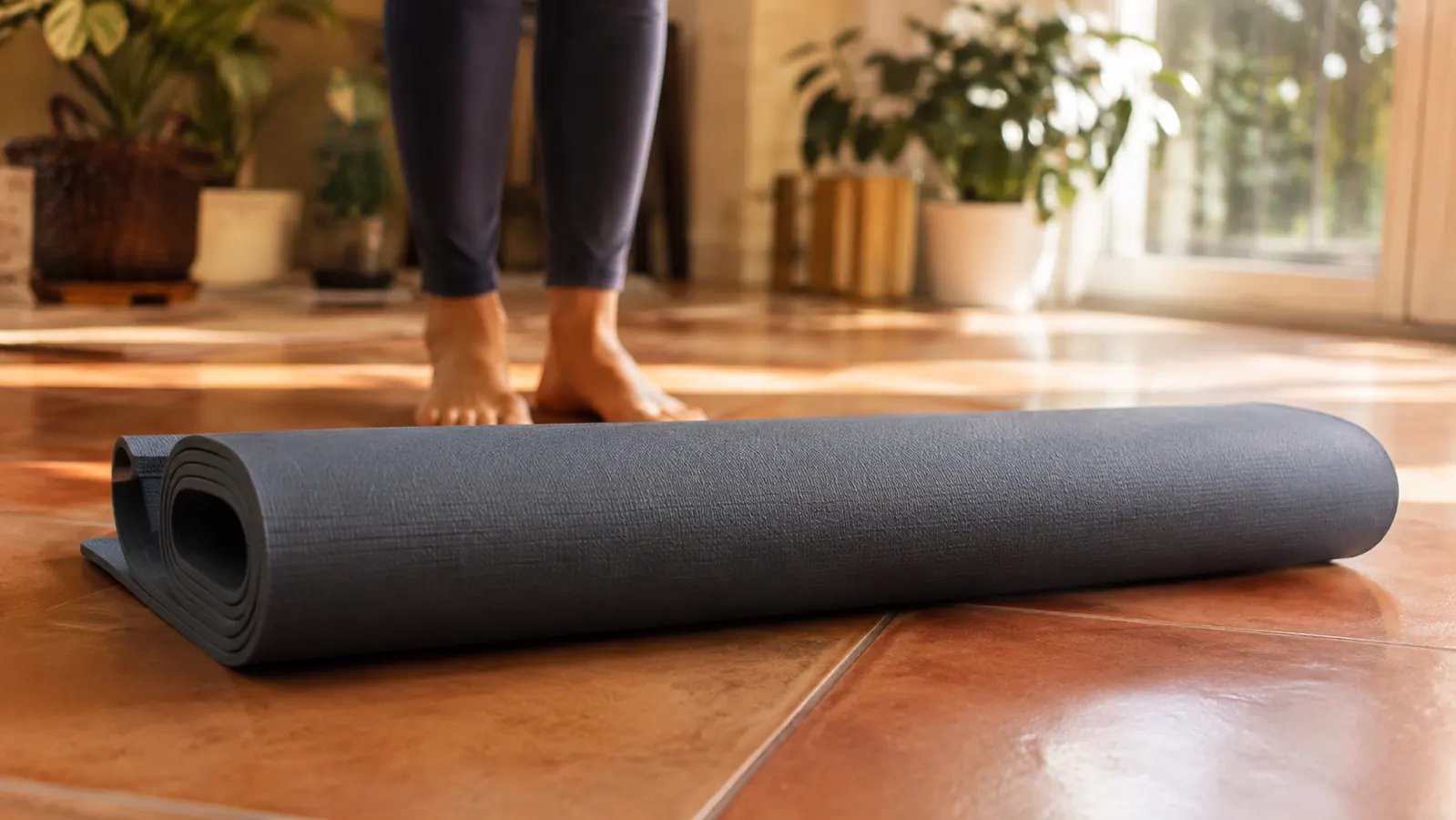
For about a year after my lower back flared up, I did almost no floor work. Not because I did not want to. Because my sunroom floor is old tile, and every time I got down on it my knees and hips let me know in a way that made me stand right back up. Stretching was supposed to help the back that had put me on the couch for six weeks. Instead it hurt somewhere new.
So I did what I suspect most of us do. I bought the cheap, thin mat that came with a mail-order exercise kit, folded it in half for double padding, and wondered why nobody made a mat thick enough that you did not have to build it out of itself. Then, four years ago, I spent about the price of a good takeout dinner on the BalanceFrom extra thick mat and stopped folding. This is what it has been like to live with it ever since, and I want to tell you the useful parts, not just the marketing version.
The Quick Verdict
A 1-inch thick, high-density mat that makes floor and kneeling work genuinely bearable for older joints, for less than most thin mats. Not a studio mat and not for balance work that needs a firm sole, but for the price it outworks everything else I have owned.
Amazon Check Today's Price →Ready to get off the hard floor for good?
The BalanceFrom extra thick mat is the one I have used almost daily for four years. If hard floors are what has been keeping you from stretching, this solves that particular problem outright.
Amazon Check Today's Price on Amazon →How I've Used It
I am Evelyn Marsh, 58, from Mesa, Arizona. Four years ago I got back into training at home after that back episode, and this mat has been on my floor for stretches, core work, kneeling hip openers, and the occasional attempt at yoga that I am still not graceful at. I am not a yoga teacher and I do not pretend to be one. I am someone whose knees, wrists, and a stubborn lower back all complain loudly, and who needed a surface that would let me keep moving anyway.
My routine looks like this. I roll the mat out in the sunroom most mornings, usually before I have had coffee. Ten minutes of floor stretching, some glute bridges, a bit of tabletop work and child's pose. Three or four days a week I add core work on it. On evenings I drag it into the bedroom for a longer session, and the carrying strap means I do not have to think about the trip. It has been unfolded and refolded literally thousands of times by now, usually rolled up tighter than a store would ever do it.
This matters because that is the long-term test that counts. A mat that feels good on day one is common. Any mat feels good the first Tuesday. A mat that still feels good after four years of daily rolls and unrolls, kneeling and re-positioning and the occasional spilled cup of tea, is rarer. That is what I am really reviewing here, because the marketing photos all look exactly alike and none of them tell you what year two is like.
The Thickness Idea, and Why BalanceFrom Gets It
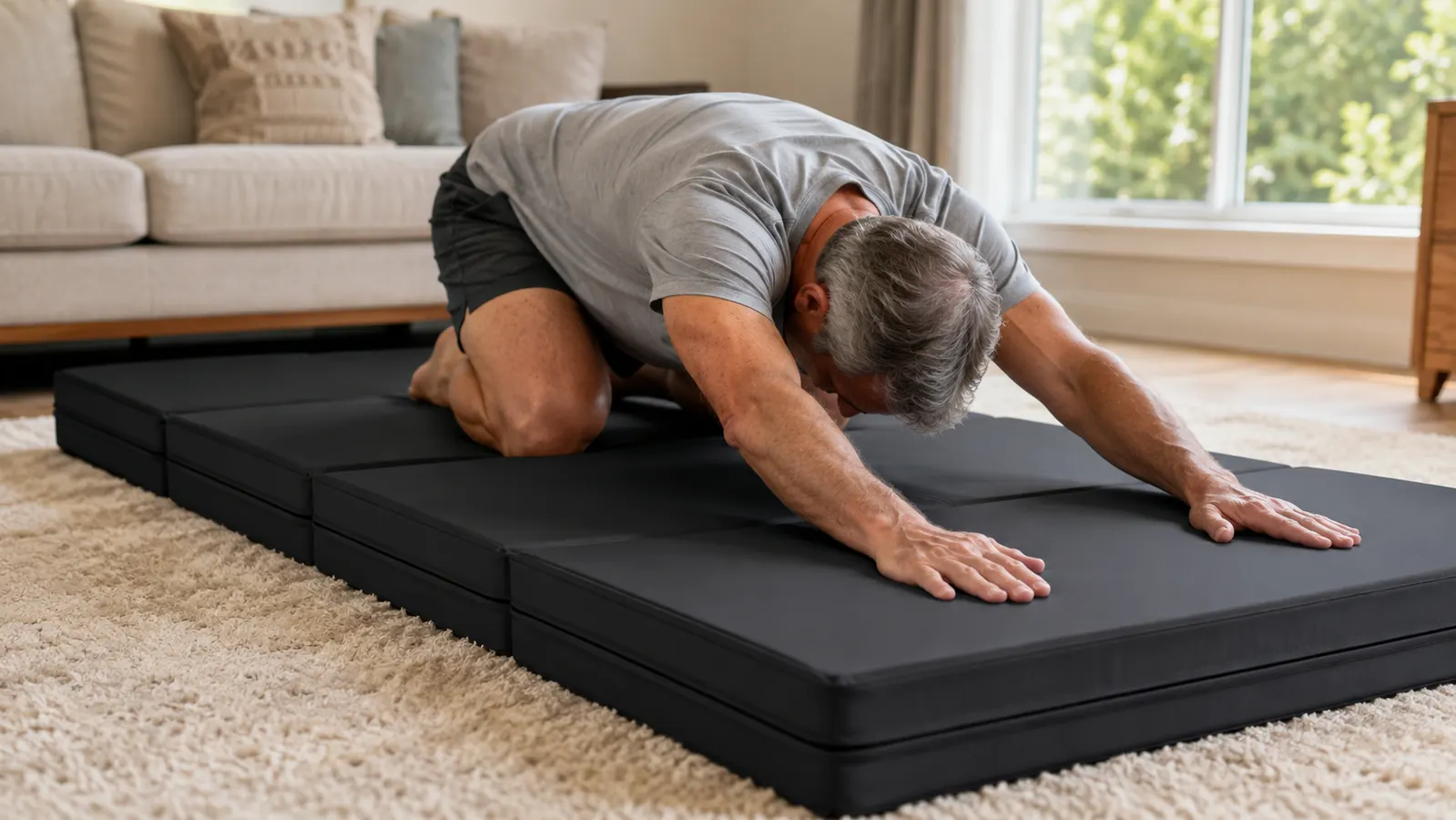
The whole point of this mat is that it is a full inch thick. That is roughly double the padding of a typical exercise mat and several times a thin yoga mat. The material is a high-density foam, and that density matters more than the raw thickness number. Cheap thick foam squishes flat under a knee within a few weeks and you are back on the floor without realizing it. High-density foam actually holds you up, and holds up.
I have knelt on this for four years and my knees do not find the tile through it. That is the entire reason it exists and the entire reason I bought it, so let me name that plainly. My wrists, which had turned against me during any kind of plank or push-up, stopped being the reason I avoided floor work. When a piece of equipment removes an excuse instead of adding a reason, it has earned its place in a home setup.
Is the inch an exaggeration, the way so many product pages exaggerate? I measured mine the day it arrived. It is genuinely close to a full inch of foam, and it has not crushed down to half that over the years the way a lesser mat would have. The carrying strap is a simple sewn fabric loop, nothing fancy, but it is strong enough that I have lugged this mat across the house a thousand times without a stitch pulling.
The Performance Tradeoff Nobody Mentions
Now the honest part, because there is always a catch with an extra thick mat. The same thickness that saves your knees makes this mat soft underfoot for standing balance work. When you stand on it, your weight sinks in just a little, and any pose that asks for a rock-solid base, like a tree pose or even just standing in stillness, feels less grounded than it would on a thin, firm mat. If you do a lot of standing balance work, this is a real downside and I will not pretend otherwise.
For my purposes it is a fair trade and I made it on purpose. I came to this mat for the floor, not the balancing acts. My balance training happens separately on a wobble board, where a cushion in the middle would be actively dangerous. But if your whole practice is standing on one leg, understand that the extra cushioning is working against you there. That is the tradeoff, stated plainly, and it is the same tradeoff baked into every extra thick mat on the market.
There is a second, smaller thing worth knowing. Because the surface is meant to grip, it can feel a little sticky under a bare foot until it warms up, and it grips laundry and towels if you toss one on top. Neither is a problem I would call a dealbreaker. Both are details nobody puts in the product description, and both are more honest to know going in.
Cleanup and Everyday Details
The mat is a lint magnet, and that is the most honest thing I can tell you about maintenance. The grippy surface picks up pet hair and dust and holds onto them until you actively wipe them off. So this is not a mat you can ignore in the corner and roll out clean three months later. A damp cloth and a few minutes after each roll handles it, but it is a habit you have to build, not a one-time thing. We have a cat, and her hair finds this mat the way it finds everything warm.
The carrying strap does its job and I will not oversell it. You sling it over a shoulder and walk. Mine has survived four years of being the way this mat moves from the sunroom to the bedroom, and the way I get it out of the way when company comes. For a mat this size it is a porch-to-bedroom carrier, not a gym bag piece, and that is fine for the audience this serves.
If you want a mat that travels to a studio daily, be honest with yourself that this one is heavy and bulky. It is not a travel mat. It is a home mat that can move rooms, and that distinction matters. I have no complaint about it being what it claims to be, only that people sometimes buy it expecting portability it does not really offer.
A mat that feels good on day one is common. A mat that still protects my knees after four years of daily rolls and unrolls is the one worth reviewing.
What I Liked
- A full inch of high-density foam that genuinely protects knees, hips, and wrists on hard floors
- Far cheaper than most thin studio mats, yet it does the one job this audience actually needs
- Included carrying strap makes moving it between rooms painless
- Survived four years of daily rolls, folds, and weight without tearing or flattening
Where It Falls Short
- Soft underfoot for standing balance poses, so it is not a one-mat-does-all answer
- Grippy surface collects lint and pet hair and needs regular wiping
- Bulkier and heavier than a travel mat, so it stays at home

What Else I Tried Along the Way
Before I settled on this one, I gave a thin promotional mat the fold-it-in-half treatment, and I borrowed a friend's expensive cork mat that I was terrified of scuffing. The thin mat put my elbows and knees straight on the floor and made the whole problem worse. The cork one was lovely and far more than I needed for kneeling stretches on tile, and I would have spent the whole session worrying about a scratch.
The BalanceFrom hits the space in between. It does not try to be a luxury studio mat. It is a practical answer to a specific problem: my joints hurt when I touch this floor. For that problem, it has been the best solution I have found, at a price that made it an easy experiment instead of a leap of faith. That low risk of trying is part of why I can review it honestly, nothing about what I spent would make me want to defend it past its merits.
I will also say this. If someone told me an inexpensive thick mat would change my habit of a lifetime, I would have rolled my eyes, and I would have been half wrong. It did not change my habits by itself. What it did was remove the physical objection that was stopping me, and that was the missing piece. Sometimes the barrier is not motivation. It is a knee that hurts on tile.
Sizing, and the One Choice That Matters
The BalanceFrom comes in a few lengths, and the one choice that actually matters is going long enough that your whole body fits without your head hanging off the edge. I am taller than average for my age group and I sized up, which was the right call. A mat that stops at your shoulders is a mat you will end up rearranging mid-stretch, and nobody needs that first thing in the morning.
The width is generous enough for anything I do on it, and I appreciated that I did not have to line myself up like I was parking a car. If you are settling on a size for the first time, err on the longer one. Every inch of extra coverage is freedom from the floor, and that is the entire point of this thing. I have never once wished mine were smaller, and I have wished plenty of mats were bigger.
Who This Is For
This mat is for anyone over about fifty who finds themselves skipping floor work because of the floor. If your knees, hips, or wrists protest when you kneel or lie on a hard surface, this removes that barrier. It is well suited to someone starting gentle stretching at home, because a forgiving surface builds confidence before it builds anything else.
It is also for the person who does not want to spend studio-mat money to find out whether they will even keep up the habit. Starting with something inexpensive that actually works, then upgrading only if you outgrow it, is the honest way to begin a home practice. Plenty of people, myself included, quit the whole idea because the first attempt cost too much and hurt the wrong places.
Who Should Skip It
If your practice is built on standing balance work, the cushioning will fight you and you would be better served by a thinner, firmer mat. That is the clearest case for skipping, and I want to be direct about it because it is the difference between loving this mat and hating it. It is not a mat for power yoga or hot flow either, both of which want more grip and a firmer base than this offers.
Skip it if you need something that lives in a gym bag and travels all day, because the weight and bulk will annoy you. And skip it if you want a low-maintenance mat you never have to think about cleaning, because the texture here will keep asking for attention. Buy it for the floor work. That is its whole reason for being, and it has no interest in being your everything.
The verdict after four years
For getting an older body off the hard floor and back into movement, I have not found a better value. It will not make you a yogi and it will not help your balance poses, and it never pretended otherwise. For the floor, it simply works, every single day.
Amazon See the Current Price on Amazon →